Experimental Validation of an Artificial Lateral Line Canal
 Work Under Embargo
Project Summary
Experimental Characterization of Subdermal Flow Sensors
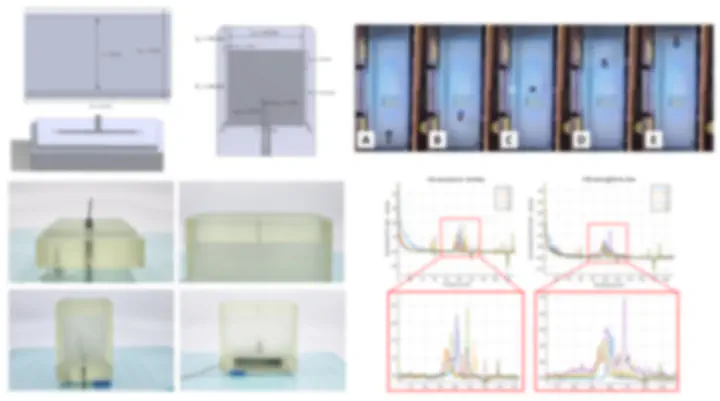
To validate the efficacy of bio-inspired canal geometries, this research focused on the physical development and experimental testing of a scaled lateral line segment. By embedding a transducing sensor (IPMC) within a bionic canal, we successfully emulated the biological ability to perceive localized flow events with high spatial and temporal resolution.
Technical Approach & Experimental Setup:
- Scaled Hardware Development: Fabricated a precise lateral line canal segment featuring external pore openings and internal “artificial neuromast” analogs.
- Sensor Integration: Successfully embedded Ionic Polymer-Metal Composite (IPMC) sensors designed to convert internal fluid displacement into measurable voltage outputs without external power.
- Dynamic Flow Testing: Conducted validation trials in a specialized flume setup, utilizing a dipole sphere stimulus to generate controlled pressure differentials across the canal.
- System Validation: Compared experimental voltage outputs against analytical predictions to assess the sensitivity, temporal resolution, and spatial accuracy of the subdermal sensing design.
Nazanin Minaian
Ph.D. in Mechanical Engineering | Research Faculty
My research interests include electroactive polymers, flow sensing, energy harvesting, and computer vision.