Bio-Inspired Noise Filtration & Fluid-Structure Interaction (FSI)
 Work Under Embargo
Project Summary
Subdermal Sensing & Computational Modeling of Artificial Lateral Lines
Biological lateral line canals are housings that additionally act as sophisticated mechanical filters that allow fish to distinguish between background turbulence and meaningful stimuli, such as a predator’s approach. This project translates these biological principles into a predictive engineering framework.
Technical Approach & Methodology:
- Analytical Framework: Established a model rooted in biological theory, specifically applying Van Netten’s treatment of cupular response to the movement of artificial neuromasts.
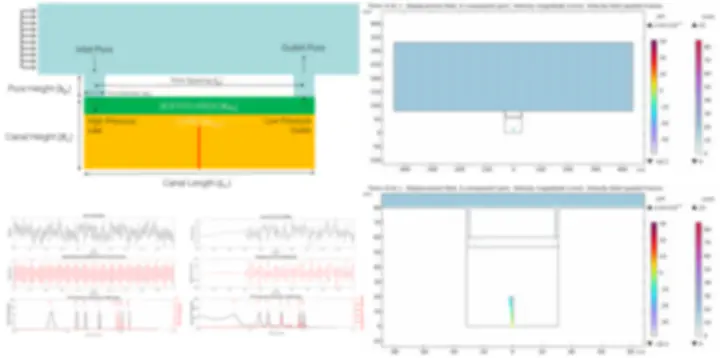
- Multiphysics Simulation: Developed a high-fidelity COMSOL Multiphysics model to investigate the two-way coupling between internal fluid flow and sensor mechanics.
- Deformation Analysis: Simulated the mechanical response of an IPMC sensor under pressure differentials induced by external stimuli, characterizing the voltage transduction potential of the system.
- Noise Filtration Theory: Analyzed how specific canal geometries and pore placements effectively dampen ambient “noise” while amplifying relevant hydrodynamic signals.
Nazanin Minaian
Ph.D. in Mechanical Engineering | Research Faculty
My research interests include electroactive polymers, flow sensing, energy harvesting, and computer vision.